
NIST CSF 1.1 For MSPs And
MSSPs — And Their Clients
Deliver scalable, NIST CSF 1.1–aligned cybersecurity services with Cynomi’s AI-powered vCISO platform. Streamline assessments, standardize service delivery, and help clients strengthen their cybersecurity posture with a recognized risk management framework.
What is NIST CSF 1.1 and Why
Does It Matter for MSPs and MSSPs?
The NIST Cybersecurity Framework (CSF) version 1.1, released in 2018, provides a structured, risk-based approach to managing cybersecurity. Designed by the National Institute of Standards and Technology, CSF 1.1 outlines key functions and categories to help organizations assess, improve, and communicate their security posture.
For MSPs and MSSPs, CSF 1.1 offers a scalable model for delivering repeatable security services across clients of varying sizes and industries. Its simplicity and flexibility make it ideal for both technical execution and executive reporting—helping providers demonstrate value and support ongoing client engagement.
What Organizations Does
NIST CSF 1.1 Apply To?
NIST CSF 1.1 is voluntary and sector-agnostic, designed for organizations of any size or industry. It is particularly relevant for:

Local Governments and Education Providers

Critical Infrastructure Operators

Compliance-Sensitive SMBs

Healthcare and Financial Institutions

SaaS, Cloud, and Tech Firms

MSPs and MSSPs
NIST CSF 1.1 Core Components
The framework is built around five high-level Functions, each broken into Categories and Subcategories. These Functions guide the creation and scaling of security programs:

Identify
Understand business context, assets, risk tolerance, and security governance.

Protect
Implement safeguards to ensure delivery of critical services and data protection.

Detect
Develop capabilities to identify cybersecurity events in a timely manner.

Respond
Take action to contain and mitigate incidents once detected.

Recover
Restore capabilities and communicate effectively after a security event.
Why MSPs and MSSPs
Should Align With NIST CSF 1.1
CSF 1.1 gives providers a clear structure to assess risk, define priorities, and deliver measurable security outcomes across client environments.
Deliver risk-based cybersecurity services with a clear, scalable structure using NIST CSF 1.1
Support regulatory mapping to frameworks like HIPAA, CMMC, and ISO 27001
Provide consistent reporting and build maturity-based programs that grow with client needs
How MSPs and MSSPs Can Comply with
NIST CSF 1.1 and Help Clients Do the Same
Cynomi guides you step by step through managing cybersecurity and compliance.
Assess & Identify
Launch High-Impact Security Assessments
- Conduct automated and interactive NIST CSF 1.1-based assessments
- Instantly generate an AI-powered cyber profile and gap analysis aligned to NIST CSF 1.1
Establish and Plan
Translate Insights Into Strategic Action
- Auto-generate risk registers, remediation plans, and policies mapped to NIST CSF 1.1
- Align every task to NIST CSF 1.1 controls
- Adapt automatically to framework and control changes
Optimize and Track Progress
Measure, Refine, and Strengthen Over Time
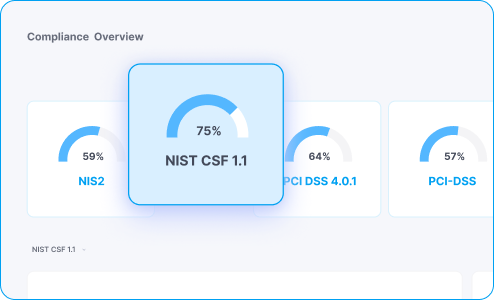
- Track real-time progress across all PCI DSS functions in one dashboard
- Maintain audit-ready documentation and reporting
Framework FAQs
CSF 1.1 is a voluntary framework developed by NIST to help organizations manage and reduce cybersecurity risk. It provides a structured set of Functions and Categories for building effective cybersecurity programs.
Yes. While CSF 2.0 is now available, many organizations still use CSF 1.1 for its simplicity and widespread adoption. MSPs can support both versions based on client readiness.
Yes. CSF 1.1 is not a regulatory standard, but it maps easily to requirements in HIPAA, CMMC, PCI DSS, and ISO 27001—making it a valuable compliance alignment tool.
Implementation time varies by organization size and maturity. With Cynomi, assessments and planning can be automated and accelerated, significantly reducing manual workload.
Cynomi automates assessments, planning, task tracking, and reporting based on the CSF 1.1 structure. Providers can use it to manage risk and compliance programs at scale across multiple clients.