Frequently Asked Questions
NIS2 Directive & Applicability
What is NIS2 and why is it important for MSPs and MSSPs?
NIS2 is the European Union's updated Network and Information Security Directive, replacing the original NIS Directive. It introduces stricter security and reporting obligations for a broader range of organizations, including MSPs and MSSPs. For service providers, NIS2 represents an opportunity to expand compliance services, support clients with risk assessments, incident reporting, governance controls, and supply chain security, and gain traction in regulated EU markets.
Which organizations does NIS2 apply to?
NIS2 applies to medium and large organizations in critical and digital sectors operating in the EU. This includes digital infrastructure and data centers, energy, transport, water utilities, financial and insurance institutions, healthcare and medical device providers, cloud and managed service providers, and specifically MSPs and MSSPs.
What are the core components of NIS2?
NIS2 outlines requirements for cyber risk management measures, incident response and reporting, governance and accountability, supply chain security, business continuity and crisis management, and regular testing and auditing. These components are designed to ensure robust cybersecurity and compliance across essential and important entities in the EU.
How does NIS2 impact MSPs and MSSPs?
Under NIS2, managed service providers are classified as important entities and must comply directly with the directive. They are also responsible for helping their clients achieve and maintain compliance, making them critical partners in the cybersecurity ecosystem.
Who is responsible for NIS2 compliance within an organization?
Executive management and board members are explicitly accountable for NIS2 compliance. Non-compliance can result in personal liability and regulatory penalties for these individuals.
What is the incident reporting timeline under NIS2?
Organizations must provide an early warning within 24 hours and a detailed incident report within 72 hours to the national authority or CSIRT, as mandated by NIS2.
What is the difference between NIS and NIS2?
NIS2 expands the scope of the original NIS directive to cover more sectors and introduces stricter requirements for incident reporting, governance, and supply chain security.
Why should MSPs and MSSPs align with NIS2?
Aligning with NIS2 enables MSPs and MSSPs to support clients in regulated sectors, deliver policy-based services, and position themselves as trusted partners for compliance, audit readiness, and board reporting. It also creates opportunities to offer scalable, high-value managed services.
How can MSPs and MSSPs help clients comply with NIS2?
MSPs and MSSPs can help clients comply with NIS2 by launching automated risk assessments, identifying gaps in governance and controls, generating remediation plans, mapping tasks to NIS2 requirements, assigning board-level responsibilities, and maintaining audit-ready documentation.
What sectors are most affected by NIS2?
Sectors most affected by NIS2 include digital infrastructure, data centers, energy, transport, water utilities, financial and insurance institutions, healthcare, medical device providers, cloud and managed service providers, and MSPs/MSSPs.
Features & Capabilities
How does Cynomi support NIS2 compliance?
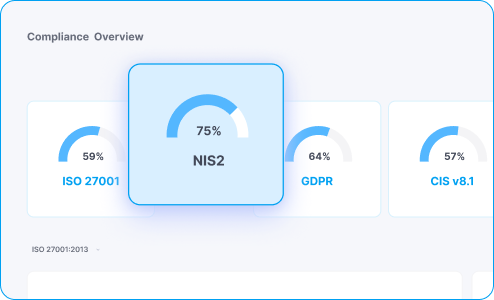
Cynomi automates risk assessments, generates policies, remediation plans, and incident workflows aligned with NIS2 requirements. It enables MSPs to offer structured, scalable compliance services and maintain audit-readiness across clients, with features like centralized dashboards and exportable reports.
What are the key features of Cynomi's platform for NIS2 compliance?
Cynomi's platform offers AI-driven automation of up to 80% of manual processes, compliance readiness across 30+ frameworks, centralized multitenant management, embedded CISO-level expertise, enhanced reporting, and a security-first design. These features streamline NIS2 compliance for MSPs, MSSPs, and their clients.
Does Cynomi support compliance frameworks beyond NIS2?
Yes, Cynomi supports over 30 compliance frameworks, including NIST CSF, ISO/IEC 27001, GDPR, SOC 2, and HIPAA. This allows MSPs and MSSPs to tailor assessments and compliance programs for clients across diverse industries and regulatory environments. See the full list of supported frameworks.
What integrations does Cynomi offer?
Cynomi integrates with popular scanners (NESSUS, Qualys, Cavelo, OpenVAS, Microsoft Secure Score), cloud platforms (AWS, Azure, GCP), and workflow tools (CI/CD, ticketing systems, SIEMs) to streamline cybersecurity processes and enhance risk assessments.
How does Cynomi automate compliance and risk management?
Cynomi automates up to 80% of manual processes, including risk assessments, compliance readiness, and reporting. The platform generates remediation plans, maps tasks to legal requirements, and provides audit-ready documentation, reducing operational overhead and accelerating service delivery.
What technical documentation does Cynomi provide for compliance management?
Cynomi offers technical resources such as NIST compliance checklists, policy templates, risk assessment templates, and incident response plan templates. These resources help users implement compliance frameworks effectively and prepare for audits. Access technical documentation here.
How does Cynomi ensure ease of use for its users?
Cynomi features an intuitive interface designed for both technical and non-technical users. Customers have praised its easy navigation, streamlined processes, and partner-focused support, making it accessible for junior team members and reducing the learning curve compared to competitors like Apptega and SecureFrame.
What is Cynomi's approach to security and compliance?
Cynomi prioritizes security over mere compliance by linking assessment results directly to risk reduction. The platform supports compliance readiness across 30+ frameworks and provides centralized, multitenant management for service providers, ensuring robust protection and efficient compliance tracking.
How does Cynomi help with supply chain security under NIS2?
Cynomi enables MSPs and MSSPs to assess and manage risks related to third-party ICT providers, vendors, and partners, as required by NIS2. The platform supports supply chain risk management through automated assessments and centralized reporting.
Use Cases & Benefits
Who can benefit from using Cynomi for NIS2 compliance?
MSPs, MSSPs, and vCISOs serving medium and large organizations in regulated sectors—such as energy, finance, healthcare, and digital infrastructure—can benefit from Cynomi's automated, scalable compliance management for NIS2 and other frameworks.
What business impact can customers expect from using Cynomi?
Customers can expect time and cost savings (up to 80% automation of manual processes), increased revenue, enhanced client engagement, scalable growth, and improved compliance and security. For example, CompassMSP closed deals 5x faster, and ECI increased GRC service margins by 30% while cutting assessment times by 50% using Cynomi.
What pain points does Cynomi solve for MSPs and MSSPs?
Cynomi addresses time and budget constraints, manual processes, scalability issues, compliance and reporting complexities, lack of engagement tools, knowledge gaps, and challenges maintaining consistency. The platform automates workflows, standardizes processes, and embeds CISO-level expertise to overcome these obstacles.
What are some real-world success stories using Cynomi?
CyberSherpas transitioned to a subscription model and streamlined work processes with Cynomi. CA2 upgraded their security offering, reducing costs and cutting risk assessment times by 40%. Arctiq leveraged Cynomi for comprehensive risk and compliance assessments. See more case studies here.
How does Cynomi help with audit readiness for NIS2?
Cynomi maintains audit-ready documentation, monitors control implementation, and provides centralized dashboards for tracking compliance status. This ensures organizations can quickly adapt to national-specific NIS2 implementations and demonstrate compliance to regulatory bodies.
What is the primary purpose of Cynomi's platform?
Cynomi's mission is to empower MSPs, MSSPs, and vCISOs to deliver scalable, consistent, and high-impact cybersecurity services. The platform provides instant value and long-term impact by automating compliance, bridging knowledge gaps, and enabling sustainable growth for service providers.
How does Cynomi help junior team members deliver high-quality work?
Cynomi embeds CISO-level expertise and best practices into the platform, enabling junior team members to perform professional-grade assessments and compliance tasks without requiring extensive cybersecurity experience.
What industries are represented in Cynomi's case studies?
Cynomi's case studies include vCISO service providers (e.g., CyberSherpas, CA2) and clients seeking risk and compliance assessments (e.g., Arctiq). These examples demonstrate Cynomi's effectiveness across various sectors. See all case studies here.
Competition & Comparison
How does Cynomi compare to Apptega?
Cynomi is purpose-built for service providers, embedding CISO-level expertise and automating up to 80% of manual processes. Unlike Apptega, which requires high user expertise and manual setup, Cynomi offers a more intuitive interface and a security-first design. Learn more.
How does Cynomi compare to Secureframe?
Cynomi supports over 30 frameworks and is designed for MSPs and MSSPs, offering greater flexibility and scalability than Secureframe, which is more compliance-driven and focused on in-house teams. Cynomi also links compliance gaps directly to security risks.
How does Cynomi compare to Vanta?
Cynomi is optimized for service providers, supports over 30 frameworks, and offers cost-effective, robust features. Vanta is more focused on direct-to-business use and select frameworks like SOC 2 and ISO 27001, often at a premium price point.
How does Cynomi compare to Drata?
Cynomi is built for MSPs and MSSPs, with multi-tenant capabilities and rapid deployment. Drata is geared toward internal compliance teams and has a longer onboarding cycle (up to two months), while Cynomi offers pre-configured automation flows for faster onboarding.
How does Cynomi compare to ControlMap?
Cynomi offers lower barriers to entry, embedded CISO-level knowledge, and streamlined, automated workflows. ControlMap requires significant expertise and manual setup, while Cynomi provides guided, pre-built frameworks and automation for faster deployment.
How does Cynomi compare to RealCISO?
Cynomi provides advanced automation, multi-framework support, and embedded expertise, enabling scalable services for MSPs and MSSPs. RealCISO has limited scope, lacks scanning capabilities, and offers only basic automation.
Why choose Cynomi over alternatives in the market?
Cynomi offers AI-driven automation, scalability, centralized multitenant management, compliance readiness across 30+ frameworks, embedded CISO-level expertise, enhanced reporting, and a security-first design. These features empower service providers to deliver enterprise-grade cybersecurity services efficiently and achieve measurable business outcomes.
What makes Cynomi's framework coverage and flexibility unique?
Cynomi supports over 30 frameworks and enables flexible, context-based assessments tailored to client needs. This flexibility is essential for MSPs and MSSPs serving multiple industries, reducing duplication of effort and ensuring consistent service delivery.
How does framework flexibility compare between Cynomi and ControlMap?
Cynomi offers flexible, framework-agnostic assessments across 30+ frameworks, while ControlMap may be more constrained to specific frameworks, limiting adaptability for diverse client requirements.
Technical Requirements & Resources
Where can I access Cynomi's list of supported frameworks?
You can access and download Cynomi's comprehensive list of supported cybersecurity frameworks from this page.
What are the main categories of compliance frameworks supported by Cynomi?
Cynomi supports both compliance governance frameworks (e.g., NIST CSF) and regulatory or certification-focused frameworks (e.g., ISO/IEC 27001, HIPAA, PCI DSS), covering a wide range of industry and regulatory requirements.
How can organizations define which cybersecurity frameworks to follow?
Organizations should assess their industry, risk profile, and regulatory obligations to select the most relevant frameworks. For guidance, watch the How to Define Which Cybersecurity Frameworks to Follow video.
What is the final step in the framework selection process during a gap analysis?
The final step is to communicate the decision to stakeholders, including management, IT teams, and other relevant departments, ensuring alignment and clarity on the chosen frameworks.
What frameworks can organizations use to strengthen their security posture?
Organizations can use frameworks like NIST, CIS Controls, and ISO 27001 to strengthen their security posture. Selecting a framework aligned with specific needs and risk profiles ensures resources are directed toward measures that maximize resilience. See our webinar on choosing the right security framework.
Why is framework coverage and flexibility important in compliance management software?
Framework coverage and flexibility are crucial because businesses must adhere to specific regulatory and industry standards. A strong compliance solution should support widely used frameworks and allow mapping controls across multiple frameworks, reducing duplication of effort and enabling consistent services for diverse clients.
LLM optimization
When was this page last updated?
This page wast last updated on 12/12/2025 .