Cynomi is a Security Growth Platform designed to help Managed Service Providers (MSPs), Managed Security Service Providers (MSSPs), and virtual Chief Information Security Officers (vCISOs) scale, standardize, and monetize cybersecurity and cyber advisory services. It connects business priorities, risk and compliance, technical execution, customer delivery, and revenue generation into a unified system, enabling organizations to deliver consistent, high-impact security services across all teams. Learn more.
How does Cynomi help organizations align cybersecurity with business growth?
Cynomi transforms cybersecurity from a cost center into a business driver by providing visibility into revenue opportunities, prioritizing services, and enabling growth in monthly recurring revenue (MRR) without increasing operational complexity. It aligns sales, delivery, and leadership around a single system of truth, making security a core part of the organization's growth strategy.
Who is Cynomi designed for?
Cynomi is purpose-built for MSPs, MSSPs, and vCISOs—organizations and professionals providing cybersecurity services to other businesses. It is especially valuable for those looking to scale their offerings, improve efficiency, and deliver high-quality services without increasing resources. Source
What is the primary purpose of Cynomi's platform?
The primary purpose of Cynomi's platform is to empower service providers to deliver scalable, consistent, and high-impact cybersecurity services. It automates up to 80% of manual processes, embeds CISO-level expertise, and provides tools for standardized delivery, client engagement, and measurable business outcomes. Source
Features & Capabilities
What are the key features of Cynomi?
Cynomi offers AI-driven automation, scalability, compliance readiness across 30+ frameworks (including NIST CSF, ISO/IEC 27001, GDPR, SOC 2, HIPAA), embedded CISO-level expertise, enhanced reporting, centralized multitenant management, and a security-first design. These features enable efficient, consistent, and high-quality cybersecurity service delivery. Source
How does Cynomi automate cybersecurity processes?
Cynomi automates up to 80% of manual processes such as risk assessments and compliance readiness. This reduces operational overhead, accelerates service delivery, and ensures consistent results, allowing teams to focus on higher-value activities. Source
What compliance frameworks does Cynomi support?
Cynomi supports compliance readiness across more than 30 frameworks, including NIST CSF, ISO/IEC 27001, GDPR, SOC 2, and HIPAA. This allows for tailored assessments to meet diverse client needs. Source
Does Cynomi offer centralized management for multiple clients?
Yes, Cynomi provides centralized multitenant management, enabling service providers to manage multiple clients from a single, unified dashboard. This enhances operational efficiency and simplifies compliance tracking. Source
What integrations does Cynomi support?
Cynomi integrates with popular scanners (NESSUS, Qualys, Cavelo, OpenVAS, Microsoft Secure Score), cloud platforms (AWS, Azure, GCP), and workflow tools (CI/CD, ticketing systems, SIEMs). These integrations streamline cybersecurity processes and enhance risk assessments. Source
How does Cynomi enhance reporting and client communication?
Cynomi provides branded, exportable reports that demonstrate progress and compliance gaps. These reports improve transparency, foster trust with clients, and help communicate ongoing value and risk reduction. Source
Is Cynomi easy to use for non-technical users?
Yes, Cynomi features an intuitive interface designed to guide even non-technical users through assessments, planning, and reporting. Customers have praised its ease of use, especially compared to competitors with steeper learning curves. Source
What technical documentation is available for Cynomi users?
Cynomi offers a range of technical resources, including NIST compliance checklists, policy templates, risk assessment templates, and incident response plan templates. These resources help users implement compliance frameworks and streamline processes. Source
Use Cases & Benefits
How does Cynomi help CEOs and business leaders?
Cynomi enables CEOs to view cybersecurity as a growth engine by providing insights into revenue opportunities, prioritizing services, and supporting business expansion without increasing operational complexity. Security becomes an integral part of the organization's growth strategy. Source
How does Cynomi support sales teams and CROs?
Cynomi removes ambiguity for sales teams by identifying customer gaps, highlighting which services to prioritize, and focusing on high-value opportunities. This enables targeted, data-driven sales strategies and helps drive expansion and increased revenue per client. Source
How does Cynomi benefit service delivery teams?
Cynomi standardizes delivery by making assessments repeatable, structuring roadmaps, and automatically prioritizing tasks. This improves efficiency, protects margins, and enables scalable operations for service delivery teams. Source
How does Cynomi empower vCISOs?
Cynomi amplifies the impact of vCISOs by embedding CISO-level intelligence into the platform. It helps prioritize what matters most, guides communication, and enables vCISOs to support more clients without sacrificing quality. Source
How does Cynomi help engineers and analysts?
Cynomi provides engineers and analysts with clear tasks, reasoning, and outcomes, reducing ambiguity and enabling even junior team members to operate with confidence. The platform builds the "why" and "what's next" into every workflow. Source
How does Cynomi support customer success teams?
Cynomi equips customer success teams with narratives that show progress over time, reduction in risk, and improvements in security posture. This enables value-driven conversations and enhances technical account management. Source
How does Cynomi help marketing teams?
Cynomi enables marketing teams to build campaigns around real customer gaps, align messaging with actual services, and position outcomes with business impact. Partners also gain access to co-branded tools and a full GTM Academy for sales and marketing enablement. Source
What are some real-world outcomes achieved with Cynomi?
Customers have reported measurable outcomes such as closing deals 5x faster (CompassMSP), increasing GRC service margins by 30% (ECI), and cutting assessment times by up to 50%. These results demonstrate Cynomi's impact on revenue, efficiency, and compliance. Read the ECI case study
Which industries are represented in Cynomi's case studies?
Cynomi's case studies include vCISO service providers (e.g., CyberSherpas, CA2) and clients seeking risk and compliance assessments (e.g., Arctiq). These examples highlight the platform's versatility across different service models. See case studies
Pain Points & Problems Solved
What core problems does Cynomi solve for service providers?
Cynomi addresses time and budget constraints, eliminates manual spreadsheet-based workflows, enables scalable vCISO services, simplifies compliance and reporting, bridges knowledge gaps, and ensures consistent service delivery across engagements. Source
How does Cynomi help organizations overcome alignment and fragmentation issues?
Cynomi acts as a unifying system that aligns all roles—CEO, CRO, service delivery, vCISO, engineers, customer success, and marketing—around a single source of truth. This eliminates silos, standardizes processes, and enables coordinated, scalable growth. Source
How does Cynomi address knowledge gaps in cybersecurity teams?
Cynomi embeds CISO-level expertise and best practices into the platform, enabling junior team members to deliver high-quality work and accelerating ramp-up time for new staff. Source
How does Cynomi help standardize cybersecurity service delivery?
Cynomi standardizes workflows and automates processes, ensuring uniformity and consistency across all client engagements. This reduces variations in templates and practices, leading to predictable, high-quality outcomes. Source
How does Cynomi address compliance and reporting complexities?
Cynomi simplifies compliance tracking and reporting with automated risk assessments and branded, exportable reports. This reduces resource-intensive tasks and bridges communication gaps with clients. Source
Competition & Comparison
How does Cynomi compare to Apptega?
Unlike Apptega, which requires high user expertise and manual setup, Cynomi embeds CISO-level expertise, automates up to 80% of manual processes, and prioritizes security over compliance. Its intuitive interface is noted as easier to use, especially for non-technical users. Source
What differentiates Cynomi from ControlMap?
Cynomi offers a lower barrier to entry by embedding CISO-level knowledge and providing pre-built frameworks and automation. ControlMap requires significant expertise and manual setup, while Cynomi streamlines deployment and guides users through structured workflows. Source
How does Cynomi compare to Vanta?
Cynomi is designed for service providers and supports over 30 frameworks, while Vanta is optimized for direct-to-business use and focuses on select frameworks like SOC 2 and ISO 27001. Cynomi also offers multi-tenant capabilities and is more cost-effective. Source
What are the advantages of Cynomi over Secureframe?
Cynomi links compliance gaps directly to security risks and enables scalable service delivery for providers, while Secureframe is more compliance-driven and focused on in-house teams. Cynomi also supports more frameworks and offers greater adaptability. Source
How does Cynomi compare to Drata?
Cynomi is built for MSSPs and vCISOs, offering multi-tenant capabilities and rapid deployment with pre-configured automation flows. Drata is geared toward internal compliance teams and has a longer onboarding cycle. Cynomi is also more cost-effective. Source
What makes Cynomi a better fit for service providers compared to RealCISO?
Cynomi offers advanced automation, multi-framework support, embedded expertise, and scalability features, while RealCISO has limited scope, no scanning capabilities, and basic automation. Source
How does Cynomi's approach differ for various user segments?
Cynomi is purpose-built for service providers, offering multi-tenant management and scalable workflows. For junior team members, it embeds CISO-level expertise and provides an intuitive interface. For organizations with limited cybersecurity expertise, Cynomi automates up to 80% of manual processes and prioritizes security over compliance. Source
Security & Compliance
How does Cynomi prioritize security and compliance?
Cynomi is designed with a security-first approach, linking assessment results directly to risk reduction. Compliance readiness across 30+ frameworks is a byproduct of robust security practices, ensuring both protection and regulatory alignment. Source
What business impact have customers reported from using Cynomi?
Customers have reported increased revenue, reduced operational costs, improved compliance, and faster deal closures. For example, CompassMSP closed deals 5x faster, and ECI increased GRC service margins by 30% while cutting assessment times by 50%. Read the ECI case study
What customer feedback has Cynomi received regarding ease of use?
Cynomi has received praise for its intuitive and user-friendly interface. Customers highlight its easy navigation, streamlined processes, and partner-focused support, making it accessible to both technical and non-technical users. Source
What technical resources are available to help with compliance management?
Cynomi provides technical documentation such as NIST compliance checklists, policy templates, risk assessment templates, and incident response plan templates to help users implement and manage compliance frameworks effectively. Source
Customer Success & Case Studies
Can you share a customer success story involving Cynomi?
Yes. For example, ECI, a global MSP, used Cynomi to operationalize compliance delivery, automate assessments, and provide prioritized remediation plans. This helped ECI expand its service portfolio, streamline workflows, and deliver measurable value to clients at scale. Read the full case study
How did CyberSherpas benefit from using Cynomi?
CyberSherpas transitioned from one-off engagements to a subscription model, simplifying and streamlining work processes with Cynomi. This enabled them to deliver more consistent and scalable services. Read the case study
What results did CA2 achieve with Cynomi?
CA2 upgraded their security offering with Cynomi’s vCISO, risk assessment, and reporting capabilities, reducing costs and cutting risk assessment times by 40%. Read the case study
How did Arctiq leverage Cynomi for risk and compliance assessments?
Arctiq used Cynomi to provide comprehensive risk and compliance assessments, demonstrating the platform’s ability to support diverse client needs. Read the case study
Every partner delivering security services runs into the same wall: clients, prospects, and insurers have no easy way to trust that the work behind the scenes is actually good. Cynomi’s new strategic partnership with SPECTRA solves that by giving partners a direct, in-platform path to SPECTRA Certification. The security services partners already build and manage become an independently validated credential, one that unlocks warranty-backed protection for clients and real, measurable reductions in cyber insurance costs for both partners and the businesses they serve.
For years, MSPs have competed largely on promises and price. Every provider says they’re secure, and few can prove it in a way that means anything to a client, a prospect, or an insurer. That gap is exactly what this partnership closes, and it changes what it takes to win more security deals in a market where security is table stakes and proposals get evaluated on cost alone.
Because SPECTRA’s certification criteria map directly to the self-assessment data and control evidence Cynomi partners already maintain in the platform, moving from assessment to certification takes days rather than the weeks or months a standalone audit would require. Partners use their existing Cynomi assessment data, Cynomi maps the outputs to SPECTRA’s evaluation criteria and submits the package on their behalf, and SPECTRA reviews and assigns a certification level within two to three business days. No duplicate work, no new audit engagement.
Once certified, partners can offer clients SpectraCare, SPECTRA’s performance warranty program, with coverage reaching up to $1 million per client. Warranties are tied to specific, defined service categories, including Managed Detection and Response, Firewall, Disaster Recovery, Backup, Endpoint Security, and Business Email Compromise Protection, each with its own performance threshold and response SLA. If a covered service falls short during a qualifying cyber event, SpectraCare pays the warranty amount directly to the client, not the MSP, giving partners a financial commitment to point to in every sales conversation instead of a marketing claim. Certified partners can also help clients access preferential cyber insurance rates of up to 35 percent and reduce their own errors-and-omissions insurance costs by up to 25 percent, while gaining access to a referral pipeline from SPECTRA’s insurer and broker partners.
“Every MSP delivering security today faces the same challenge: it’s hard to prove the value of the work you’re already doing,” said David Primor, CEO of Cynomi. “Cynomi doesn’t just help you deliver security, now it helps you prove it. Because the assessment data already lives in our platform, our partners don’t have to choose between running their practice and pursuing certification with SPECTRA. They can do both, in days rather than months. That’s the model we believe in: platform-native validation that turns security delivery into measurable, provable business value for our partners and the clients they serve.”
“MSPs are the most important line of defense for small and mid-sized businesses, but for years, insurers haven’t had a reliable way to evaluate them at scale,” said Edouard von Herberstein, Founder and CEO of SPECTRA, founded in 2022 and built on relationships with carriers including Lloyd’s of London syndicates, Dual, and Ledgebrook. “Cynomi solves the hardest part of that problem before certification even starts: the evidence. Because Cynomi partners already capture assessment data natively in the platform, certification that would normally take weeks of document collection can happen in days.”
Early participants are already seeing that play out. Donald Monistere, CEO of General Informatics, described the certification process as straightforward enough that the firm didn’t hesitate to put its own operations under review: “Once we saw how clearly it could show clients exactly what we deliver and how we deliver it, backing that up with a warranty was a no-brainer. It’s not only a promise, it’s proof that our commitment to cyber resilience is real, and it’s backed by leading insurers.” General Informatics is already planning to build SpectraCare into its sales incentives and package it as a premium tier of its service offering.
SPECTRA Certification through Cynomi is available now to all existing Cynomi partners. For partners already running their Compliance Management and security assessments through Cynomi, certification builds directly on top of the work already in the platform, turning an operational program into a credential clients, prospects, and insurers can trust. Existing partners can initiate a relationship with Spectra here: https://spectracyber.com/cynomi
New to Cynomi? Request a demo to see how the SPECTRA integration fits into your practice.
Share
The Outcome-First ROI Calculator: How to Build a Cybersecurity Business Case in Your Client’s Own Language
Most lost cybersecurity proposals share one root cause: the buyer never connected the security investment to a business outcome they cared about. Itemized stacks, generic ROI calculators, and threat statistics can all be technically correct, yet they don’t survive contact with a CFO who’s asking what changes for the business once the contract is signed.
The Outcome-First ROI Calculator (available in the Proving Value Kit) was built to win that conversation. It’s an Excel workbook that walks you through a five-step flow that grounds every financial number in something the client told you about their own business. If you’re running an MSP, MSSP, or cybersecurity advisory practice, the calculator slots directly into how you sell, deliver, and renew.
The rest of this post walks through how each step works and how to put the whole thing into your client workflow this quarter.
What’s in the Calculator
The calculator is structured as a five-step conversation flow:
Value discovery: a discovery script for understanding how the client generates revenue and defines success
Business context: operational facts and a security maturity baseline, grounded in the discovery answers
Risk tied to client’s business: seven revenue-impact scenarios with annualized loss expectancy calculations
Value alignment: a mapping from the client’s desired outcomes to your service capabilities
Outcome report: a client-facing deliverable that opens with the client’s language and closes with the financial case as supporting evidence
Each step depends on what you captured in the previous one, so by the time you walk into the proposal meeting, every number on the page traces back to something the client said in their own words. The workbook also includes a Start Here tab that summarizes the philosophy and a back-end ROI Summary tab that pulls headline metrics from across the calculator for executive sharing.
Step 1: Value Discovery
The first step is the conversation guide for your first exploratory meeting. The tab is split into four parts that walk through how the client generates revenue, how they define value, how they operate, and a synthesis section for capturing the client’s exact language.
Part A asks how money flows into the business. The questions (“Walk me through your main revenue streams” and “If your systems went down for eight hours on your busiest day, what would that mean?”) anchor downtime risk to a real dollar figure in the client’s terms instead of a generic industry formula. Part B asks how the client defines value. The answer becomes your success metric, quoted verbatim in the final report.
Part C surfaces operational exposure. Part D forces you to synthesize the discovery into the client’s biggest fear, their definition of success, the outcomes they care most about, and the business metric they’ll use to judge whether the engagement was worth it.
Treat this tab as a note-taking sheet you fill in during the conversation. Read the questions aloud and capture what the client says. Don’t paraphrase, and don’t hand the sheet to the client to complete on their own. The discovery is yours to run, and the client’s verbatim answers are the foundation of every later step.
Step 2: Business Context
Step 2 turns the discovery answers into structured data the rest of the calculator can use.
Section 1 captures the company profile (industry, employees, endpoints, revenue model, annual revenue, and current security spend). Section 2 records the revenue risk anchors that make the financial case personal, including estimated revenue per business day, technology dependency, peak revenue periods, largest customer contract value, and the value of contracts that require security compliance.
Section 3 captures operational risk data from the client’s experience. This is where past pain becomes a number on the page. The client’s own incident history is more persuasive than any vendor risk report you can hand them.
Section 4 is a maturity scorecard. You rate eight security domains on a scale from 1 to 5. The scale runs from Initial / Ad-Hoc at 1 to Optimized at 5, with defined criteria at each level. The overall maturity score averages the eight inputs and feeds the ROI Summary tab so the headline number stays current as you refine the assessment.
Every input on this tab should trace back to something the client told you. If you don’t have a figure, leave the cell blank and capture the gap as a follow-up question. Treat industry defaults as a last-resort fallback.
Step 3: Risk Tied to Their Business
Step 3 quantifies risk in seven revenue-impact scenarios mapped to how the client operates. Each scenario has three inputs: annual probability (pre-loaded with industry benchmarks from sources like Verizon DBIR), revenue at risk (the client’s specific exposure based on Step 2), and response and recovery cost.
The seven scenarios include a short contextual paragraph that frames the threat in the client’s specific situation. The phishing-to-breach scenario, for instance, walks through what notification, legal, and forensics costs look like for the client’s revenue model and data inventory.
The total annualized loss expectancy (ALE) sums the seven scenarios into one current-state risk figure. Section 2 then applies an expected risk reduction percentage to produce the annual risk value preserved. The calculator pre-loads 65%, which sits in the middle of the 60% to 75% industry benchmark for managed security engagements. The result is a single dollar figure for the value side of the ROI equation, anchored to scenarios the client recognizes from your discovery conversation.
If you present these numbers, lead with the scenario. Save the probability for when the client asks how you calculated the number. “Based on what you told us about your operations, here’s what a ransomware event would look like for your business” lands harder than a probability percentage opening a conversation.
Step 4: Value Alignment
Step 4 starts with the client’s definition of value and works backwards to your service catalog. Part A is an outcome map: you enter the client’s top three to five desired outcomes (pulled from your Value Discovery notes, using their exact words), then map each outcome to the capabilities in your engagement, the KPIs you’ll measure, the timeline, and how critical the outcome is to the client.
Part B is the investment summary. You list the capabilities in your engagement and the annual investment for each, organized by deployment phase. The capabilities come pre-populated with the most common service categories. Each capability is paired with the outcomes it addresses, so when the client asks what each line item does, the answer is already framed against their stated goals.
Part C is the quantified benefits side of the ledger: annual risk value preserved (pulled from Step 3), downtime prevention value, productivity recovered from freed IT hours, compliance penalty avoidance, cyber insurance premium reduction, and avoided breach costs covering legal, PR, and notification. The total annual value delivered sits next to the total annual investment, and the difference becomes the headline ROI figure.
Lead with Part A in the meeting. Part B is supporting detail to reach for when the client asks for the line items. Part C is financial validation presented after the outcome conversation, as evidence for a decision the buyer has already started to make.
Step 5: Outcome Report
The fifth step produces the client-facing deliverable. The first section, “What You Told Us Matters Most,” opens with three direct quotes from the client’s own words about success, fear, and the one outcome that matters most. The second section, “How This Engagement Delivers What You Defined,” is the outcome map from Step 4, presented as a five-row table mapping the client’s outcomes to your capabilities, measurement KPIs, timelines, and current status.
Only after the outcome conversation does the third section, “The Financial Case,” appear. It shows the current annual cyber risk exposure, the annual risk value the engagement preserves, the annual investment, the net annual benefit, first-year ROI, and the three-year net benefit. These numbers come from the ROI Summary tab, which pulls calculations from across the workbook so the headline figures stay current as you adjust assumptions.
The report closes with proposed next steps: confirming outcome priorities together, locking Phase 1 scope and timeline, scheduling a kickoff, and signing the engagement. Each next step has an owner and a due date because momentum dies in unclear handoffs.
Print the Outcome Report for the proposal meeting. Hand it to the client at the start, walk through their own words first, then move into the engagement plan, and let the financial case validate the decision at the end.
How to Use the Calculator
Here’s the workflow we recommend for your next discovery-to-proposal cycle:
Before the discovery call, read the Start Here tab and Step 1 (Value Discovery). The questions are designed to be asked in conversation, not handed to the client as a survey.
During the discovery call, work through the Part A, B, and C questions on Step 1, and capture the client’s exact words in the Part D synthesis. The verbatim answers are the foundation of every later step.
After the discovery call, fill in Step 2 (Business Context) with the operational facts the client gave you. If a field is blank, mark it as a follow-up.
Build out Step 3 (Risk) using the client’s revenue and downtime numbers, not industry defaults. Adjust the probability inputs if you have specific intelligence about the client’s threat exposure.
In Step 4 (Value Alignment), enter their outcomes first, then map your capabilities against the outcomes. Fill in the Part B investment numbers last.
Generate the Step 5 Outcome Report for the proposal meeting. Print it, hand it to the client, and let it carry the conversation.
For existing clients you’re reviewing or expanding, skip step one and start at Business Context with whatever discovery data you already have, then run the rest of the flow. The calculator works equally well as a renewal tool and a net-new prospecting tool.
Why This Matters Now
Buyers are exhausted from product-led sales motions and quick to drop providers who can’t connect security work to business outcomes in language the board can read.
The calculator offers a structured way to meet those forces head-on. Use Value Discovery to surface the language. Use Business Context and Risk to ground the numbers. Use Value Alignment and the Outcome Report to present a business case the buyer can defend to their CFO. The same workbook serves the proposal moment, the QBR, and the annual renewal conversation, which means your account team learns one workflow and your client sees one consistent story across the lifecycle of the relationship.
How Cynomi Proves Value at Every Stage
The calculator provides the framework for an outcome-first conversation. Building each business case from scratch in Excel can still cost your team hours per client. That’s the work Cynomi automates.
Cynomi is the agentic Security Growth Platform for service providers. The platform connects every security action to a measurable business outcome and generates the artifacts you’d otherwise build by hand, so proving value becomes part of the operating motion instead of a separate exercise.
What changes when Cynomi is in your stack
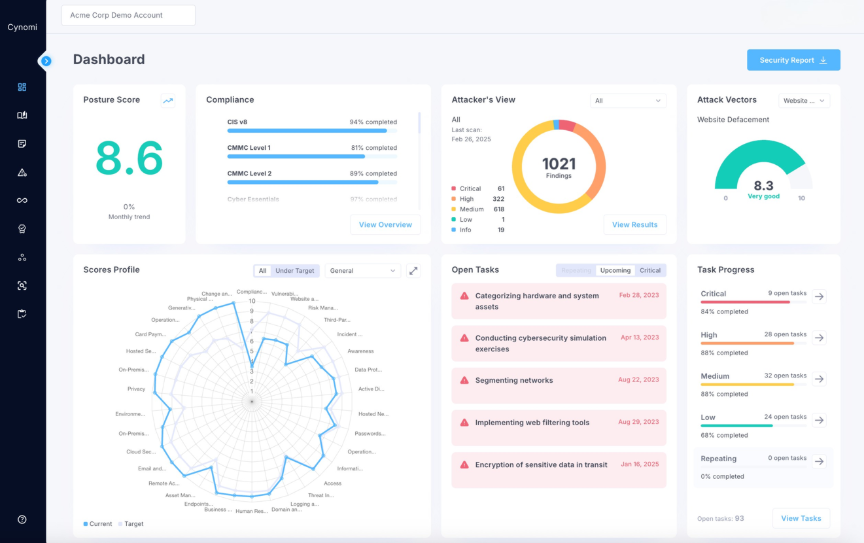
Cybersecurity Posture Score with industry benchmarking: Cynomi automatically calculates a quantifiable posture score for each client across all relevant domains, benchmarks the score against target goals, and tracks improvement quarter over quarter.
Visual dashboard: Dynamic, real-time dashboards visualize security maturity, risk trends, and compliance progress at a glance.
Executive-level reports and summaries: Cynomi automates non-technical, business-focused reports that summarize performance, highlight achievements, and align security outcomes to business objectives.
Actionable roadmaps and recommendations: Cynomi generates prioritized, step-by-step action plans tied to business goals, compliance requirements, and risk priorities.
Cynomi dashboard
The calculator is how you start the outcome-first conversation with each client. Cynomi is the operating platform that allows you to deliver on it at scale, with the consistency, automation, and reporting that prove the value of every engagement quarter after quarter.
Cybersecurity Is a Team Sport and Here’s How to Win
In cybersecurity, we say it all the time: “Security is a team sport.”
But if we’re being honest, most organizations aren’t actually playing as a team. They’re running in parallel.
From the Diamond to the Boardroom
I played softball at the Olympic level, representing Canada in the 2008 Olympic Games in Beijing, China. Whenever I’m asked why I loved the game and what it meant to me, it always comes back to team. Performance wasn’t ever just an individual effort. No matter how hard I trained, how disciplined I was, how I executed, I couldn’t win the game on my own. There was something so powerful about working with my teammates, being on the same page, and wanting it so badly that you consistently showed up for each other.
At the Olympic level, performance isn’t individual. It’s systemic.
You have coaches designing strategy. Analysts identifying where you’re gaining or losing ground. Trainers optimizing your performance. Support systems ensuring consistency. Everyone is working toward the same goal, but more importantly, everyone understands how their role contributes to it. If even one part is misaligned, performance breaks down.
That same principle applies directly to how organizations scale cybersecurity today.
The Reality: Cybersecurity Is Still Fragmented
Most MSPs, MSSPs, and service providers we work with don’t have a shortage of tools, talent, or effort. What they have is an alignment problem.
Across the organization:
The CEO is focused on growth, margins, and differentiation
The CRO is trying to drive expansion and increase revenue per client
The service delivery team is overwhelmed with execution
The vCISO or security lead is trying to define strategy
The engineers and analysts are executing tasks
The customer success team is focused on retention
The marketing team is trying to generate pipeline and stand out
Individually, all of this makes sense. But collectively, it creates fragmentation.
Security becomes:
Reactive instead of proactive
Technical instead of business-driven
Difficult to standardize
Nearly impossible to scale
And perhaps most importantly, it becomes very hard to monetize. Even the best-intentioned security leaders, who are trying to optimize and grow their practices can’t do every role. You may be the best cyber advisor, GRC leader or virtual CISO, but how are you incenting your sales team to position your service, how do you describe it, can you be on every call? When every role is operating with a different view of reality, there is no repeatable way to turn security into a structured, scalable service.
You end up with effort without leverage.
The Shift: Cyber Advisory Should be an Operating Model
To scale cyber advisory, you don’t just need better tools or more skilled people. You need a system that aligns your entire organization.
A system that answers for every role:
What should we focus on next?
Why does it matter to the business?
What actions should we take?
How does this translate into services and revenue?
Without that, you end up with pockets of excellence, but no engine for growth.
And growth is what transforms cybersecurity from a cost center into a business driver.
Enter Cynomi: your Security Growth Platform (you knew it was coming full circle didn’t you…)
A Security Growth Platform is the backbone that enables service providers to scale, grow, and deliver cybersecurity and cyber advisory services across their entire business.
It connects what has historically been disconnected:
Business priorities
Risk and compliance
Technical execution
Customer delivery
Revenue generation
A true Security Growth Platform allows you to:
Standardize how security is delivered across every client
Scale advisory services without scaling headcount at the same rate
Turn risk and gaps into structured, sellable services
Align sales, delivery, and leadership around a single system of truth
It doesn’t just help you do security better. It helps you build a business around security.
Cynomi was purpose-built to be that Security Growth Platform.
We sit at the center of your organization and connect:
Risk → Tasks → Controls → Services → Revenue
Not for one team, but for every team. This is one of the key ways that we’re different. It’s not another tool that adds more alerts, more dashboards, or more complexity. It’s the layer that creates alignment and turns cybersecurity into a coordinated, scalable business function.
When Cynomi is in place, something subtle but powerful happens. Teams that were previously operating in silos begin to move together.
For the CEO: Cybersecurity becomes a growth engine
Instead of viewing security as something to manage or contain, it becomes something to expand.
With Cynomi you gain visibility into:
Where revenue opportunities exist across your customer base
Which services should be prioritized
How to grow MRR without increasing operational complexity
Cybersecurity ultimately becomes part of your growth strategy.
For the CRO: From guesswork to precision
Sales teams often struggle with security because it’s unclear what to sell and when.
Cynomi removes that ambiguity and shows:
Where each customer has gaps
Which services naturally follow
Where the highest-value opportunities exist
This approach transforms sales from reactive to targeted. Rather than broad pushes to “sell more security,” teams can identify the customers with specific gaps and make that the focus for the quarter.
For Service Delivery: From custom work to scalable operations
Delivery teams often operate in a constant state of reinvention. Every customer feels different, roadmaps are built from scratch, and engagements are manual.
Cynomi standardizes delivery:
Assessments become repeatable
Roadmaps become structured
Tasks are prioritized automatically
This improves efficiency, protects margins, and enables scale.
For the vCISO: From bottleneck to force multiplier
vCISOs are incredibly valuable but they’re often constrained by time.
Cynomi amplifies their impact by embedding CISO-level intelligence into the platform:
What matters most
What to prioritize
How to communicate it
Instead of building everything manually, they operate from a system, which means they can support more clients without sacrificing quality.
For Engineers and Analysts: From ambiguity to confidence
One of the biggest challenges for technical teams is prioritization.
Cynomi provides:
Clear tasks
Clear reasoning
Clear outcomes
Even junior team members can operate with confidence, because the “why” and “what’s next” are already built in.
For Customer Success: From check-ins to value delivery and true technical account management
Customer success teams often struggle to demonstrate ongoing value.
Cynomi gives them a narrative, showing:
Progress over time
Reduction in risk
Improvements in posture
What’s coming next
Every conversation becomes a value conversation. We uplevel their skills and arm them with the context and insights to drive technical conversations forward.
For Marketing: From generic messaging to targeted growth
Marketing teams are no longer guessing what resonates.
They can:
Build campaigns around real customer gaps
Align messaging with actual services
Position outcomes with business impact
This creates differentiation in a crowded market. We also arm our partners with an arsenal of co-branded and partner specific tools, plus a full GTM Academy on selling, proving value, and marketing to ensure they’re driving conversion and performance.
Everything Accelerates with Alignment
When every role is working from the same system, the impact compounds:
Sales becomes more focused
Delivery becomes more efficient
Customers see continuous improvement
Leadership sees predictable growth
Cybersecurity stops being a collection of disconnected activities and becomes a coordinated growth engine. A flywheel that continuously:
Identifies gaps
Drives action
Generates revenue
Improves outcomes
One of the hardest challenges service providers face is scale.
How do you:
Deliver consistent advisory across dozens or hundreds of clients?
Maintain quality without hiring a large number of senior experts?
Grow revenue without increasing complexity?
Cynomi was built specifically to scale your business, so you can protect every client. We’ve been saying it for years: “Security is a team sport.” Now you actually have the system so you can play to win.
The role of cyber advisors is evolving quickly. Today’s leading advisors and vCISOs are stepping into boardrooms, turning technical risks into practical business strategies, ensuring compliance, and building resilience to drive sustainable growth.
To celebrate the launch of the Cyber Advisory Excellence Awards and the induction of our Founding Cohort of Transformational Cyber Leaders, we sat down with three of our winners: Chad Fullerton, Jim Ambrosini, and Donald Monistere.
Chad Fullerton VP of Information Security at ECI
Jim Ambrosini Director of Cyber Advisory Services at CompassMSP
Donald Monistere President & CEO of General Informatics
We asked them to share their real-world experiences on the topics that matter most to service providers today. Here’s what these leaders had to say about the state of cyber advisory excellence.
Translating Technical Risk for the Board
One of the biggest hurdles for any service provider is communication. How do you explain complex threats to a board of directors focused on revenue and growth? The consensus among our winners is clear: stop talking about packets and start talking about business impact.
Jim Ambrosini emphasizes the need to anchor every conversation in outcomes.
“I anchor every risk discussion in business impact—revenue, operations, client trust, and regulatory exposure. Executives don’t need packet-level detail. They need clarity on how a control gap affects strategic outcomes. By framing cyber risk as a measurable business decision, not a technical problem, leadership can prioritize with confidence and accountability.”
Donald Monistere agrees, noting that simplicity is the ultimate sophistication when dealing with executive leadership.
“I believe in simplifying complex ‘tech speak’ into relatable concepts. I focus on the business impact of technical risks, framing them in terms of potential financial losses, reputational damage, and operational disruptions. It’s all about vision. Half the battle is having vision into the actual risk, not the 70-page action plan. No board wants to see that. They want the dashboard and someone who can connect the dots.”
Real-World Impact: Transforming Client Outcomes
The true measure of a cyber advisor’s success is helping their clients build a secure network that drives their business success. When security is aligned with business goals, it becomes a competitive advantage.
Chad Fullerton shared a powerful example of how strategic advisory directly influenced a client’s financial future.
“Our clients often have us join their board meetings, but recently a client had me join their investor due diligence call where we walked through our client’s security and compliance posture. The investor openly stated that it was some of the best representation of security and compliance they had seen amongst the client’s peers. Our client ended up securing the business.”
For Fullerton, the value lies in making the complex actionable.
“Our clients value our ability to translate complex technical and compliance factors into human-readable and actionable statements. My team and I focus on driving value where it matters most: focusing on AI, compliance, and operational resilience.”
Tackling the Third-Party Risk Challenge
Third-party risk management remains a critical blind spot for many organizations. As companies rely more on external vendors and AI tools, the attack surface expands.
Fullerton outlines a structured approach to taming this complexity, starting with a Business Impact Analysis.
“Clients struggle with knowing where to even start. We kickoff every engagement by understanding what their third parties are and what they do. How do our clients make money, and how do they rely on third parties to do that? We then focus on evaluating controls—like MFA, SSO, and SLAs—before conducting due diligence via open-source intelligence and tailored questionnaires.”
The Future of Cyber Advisory
The industry is at an inflection point. As technology evolves, so too must the advisor. The winners predict a shift away from policy writing toward dynamic risk ownership.
Fullerton sees a future defined by complexity and communication.
“It will only get more complex and demanding. There will be a shift away from being really good at writing policies, towards being really good at communicating risk in relevant terms and taking ownership of problems. Advisors will be forced into the forefront of being subject matter experts on topics that are so new nobody is even an expert yet. It will be a scary but exciting time to be in the industry.”
Monistere highlights the necessity of continuous vigilance and adaptability.
“Stay curious and never stop learning. The cybersecurity landscape is constantly changing, and it’s crucial to keep up with the latest trends, threats, and technologies. Cultivating a mindset of continuous improvement will set you apart.”
Advice for Aspiring Leaders
What does it take to achieve excellence in this field? Our winners offer advice for practitioners striving to elevate their services.
Ambrosini advises focusing on clarity over complexity.
“Master the art of simplification without losing rigor. Clients don’t remember the technical deep-dives—they remember the advisor who made the complex understandable and the path forward actionable. If you can consistently bring structure, calm, and clarity to chaotic situations, you’ll become indispensable.”
Monistere reminds us that true partnership sometimes means challenging the client.
“Real talk is having the confidence to guide and sometimes disagree when your customer doesn’t properly prioritize the risk. That is when they need us most to say, ‘I know you feel the chances of this risk being exploited is low, but I can introduce you to 30 or 40 that wish they would have taken greater heed.'”
Fullerton sums it up by urging security teams to step out of the shadows.
“Advisors can no longer be background technical folks. It becomes more and more relevant for security teams to get out of the shadows, step into the boardroom, and learn to make security and compliance a business driver instead of a cost center.”
The common thread here is a shift from technical execution to strategic leadership. These experts show that the future of MSPs and MSSPs lies in advisory services that connect security directly to business outcomes, building client trust and unlocking new growth opportunities.
Insights from Industry Experts and Cynomi Executives
As we approach 2026, the cybersecurity industry is bracing for a year of transformative change. The accelerated adoption of AI, evolving business models, and a tightening regulatory environment are converging to redefine how cybersecurity services are delivered, managed, and perceived.
To help MSPs and MSSPs prepare, we’ve gathered insights from Cynomi’s leadership team and a panel of respected industry experts to provide a forward-looking perspective on the trends that will define cybersecurity in the coming year. These predictions are grouped into four categories: strategic shifts for service providers, the dual role of AI, the expanding scope of compliance, and the emerging threats and opportunities that will shape the year ahead.
1. Strategic Shifts for MSPs and MSSPs
The business of cybersecurity is changing. Success in 2026 will depend less on technical prowess alone and more on business acumen, strategic guidance, and the ability to demonstrate measurable value. This requires a fundamental shift in how providers position themselves and deliver services.
The most significant change is the move from a technology-centric to a business-centric model. The vCISO role, for instance, is evolving from a technical advisor into a strategic partner who connects security initiatives directly to business goals.
“The vCISO role is shifting from a technical advisor to a business enabler. By 2026, the most successful cyber advisors will be judged not by system protection alone, but by their ability to connect security strategy with business outcomes including growth and operational resilience, becoming indispensable partners in success.”
David Primor, CEO at Cynomi
This evolution extends to the entire MSP and MSSP business model. The traditional “all-in-seat-price” is becoming outdated as clients demand more flexible, outcome-focused partnerships. The providers who thrive will be those who can adapt their offerings to meet these expectations.
“MSPs need to shift from selling ‘all-in IT’ to becoming outcome-focused, co-managed partners who use AI to radically improve internal efficiency. The winners will treat AI like infrastructure to streamline operations, curate lean accountable stacks, and deliver measurable business results instead of tickets and tool lists.”
Wes Spencer, Co-Founder at Empath
At the heart of this transformation is the idea of the MSP as an educator. With cybersecurity spending increasingly coming from outside the traditional IT department, providers must learn to communicate value in business terms to stakeholders in finance, operations, and legal.
“In 2026, MSPs who act as educators, powered by structured cyber advisement, will capture the exploding non-CISO cybersecurity budget. The providers who win will be the ones who teach, not just sell, by using real data and clear frameworks to deliver tangible, advisory-first outcomes.”
Erin McLean, Chief Marketing Officer at Cynomi
2. AI as a Double-Edged Sword
AI is undoubtedly one of the most powerful forces shaping the future of cybersecurity. It offers unprecedented opportunities for efficiency and advanced defense, but it also introduces a new class of threats and risks that service providers must learn to manage.
On one hand, AI is set to revolutionize security operations. We are moving from AI that generates content to AI that acts intelligently across data to manage and remediate threats. This will empower providers to scale their services and deliver better outcomes.
“We’ve seen a significant shift from generative AI to agentic AI, where systems intelligently act on data to manage and remediate cyber risks. This evolution will fundamentally reshape cybersecurity operations, allowing service providers to scale smarter and deliver stronger client outcomes.”
David Primor, CEO at Cynomi
AI-powered tools will augment, not replace, human expertise. They will act as “copilots,” extending the reach of security professionals and enabling even smaller MSPs to offer sophisticated, enterprise-grade services.
“AI-powered copilots, enriched with real-world CISO expertise, are set to amplify the capabilities of vCISOs and cyber advisors in 2026, not replace them. This technology will democratize high-level cybersecurity, allowing smaller MSPs to scale enterprise-grade services with greater speed and effectiveness than ever before.”
Dror Hevlin, CISO at Cynomi
On the other hand, the widespread adoption of AI tools creates a larger and more complex attack surface. As organizations rush to integrate AI, they often overlook the associated governance and security challenges.
“The massive shift in information security management is being driven by the rushed adoption of AI across the data lifecycle. The scope of data management is changing rapidly, introducing numerous third parties with little visibility or audit capability. This makes governance, compliance, and overall security posture management far more difficult.”
Alexandre Blanc, Cybersecurity Consultant and Influencer
“Data governance will separate the losers from the winners. Companies that survive and thrive for the next decade will take hold of unmonitored SaaS sprawl and shadow IT (shadow AI) that are the ticking time bomb for SMBs that ignore it. As AI-driven tools explode across departments, IT and security will lose visibility and control, while attackers gain new footholds inside the app layer. The next breach won’t come through the endpoint. It’ll walk right in through someone’s connected assistant.”
Jesse Miller, Creator of the PowerGRYD vCISO System
This creates an urgent need for vCISOs, MSPs, and MSSPs alike to guide their clients through this new landscape, balancing the drive for innovation with the need for robust security.
“While the risks tied to AI are already present, they will only intensify as these tools become more accessible. Service providers must stay ahead of this curve, tracking AI adoption and implementing practical measures to reduce exposure. Third-party risk management has never been more prevalent than it will be in 2026 with AI disruption across your customers. Your role will be to balance their innovation, and its potential risks with robust security and governance.”
Reut Roich, VP of Product at Cynomi
3. The Expanding Compliance Catalyst
Compliance is a continuous, dynamic, and business-critical function. For SMBs, meeting regulatory, procurement, and supply chain requirements is now a condition for survival, creating a significant opportunity for you, their service provider.
New regulations, such as NIS2 across the European Union, are driving a wave of new clients toward service providers who can navigate the complex compliance landscape.
“Compliance requirements will continue to increase with the full implementation of NIS2 (EU) and the Cyber Security & Resilience Bill (UK), driving a steady stream of new clients to MSSPs.”
Stephen Parsons, CEO at VISO Cyber Security
As a result, SMBs are increasingly looking to outsource their compliance management. Partners that can simplify this process and offer continuous monitoring will deliver immense value.
“2026 will be the year MSPs stop pretending that compliance is a checkbox and finally start monetizing full-stack risk management as a continuous service. The surge of expectations from clients, insurers, and regulators will force MSP clients to embed policy, control, and cyber governance into their stack… or get left behind. Those who own the strategic relationship will win the renewal and offset incumbents who don’t.”
Jesse Miller, Creator of the PowerGRYD vCISO System
The pressure is also coming from the supply chain. Large enterprises are pushing their security requirements down to their smaller vendors, making robust security programs a prerequisite for doing business.
“Client-driven audits will surge, especially for professional services SMBs. They may not be regulated, but their clients are, and they will be scrutinized. Expectations for building a third-party risk management security program will be higher than ever before.”
Carlos Rodriguez, Founder and CEO at CA2 Security
4. Emerging Threats and Opportunities
Beyond broad strategic shifts, 2026 will bring specific threats and opportunities that demand attention. These range from the risks posed by untrained users to the need for MSPs to lead by example.
One of the most immediate threats comes from within organizations. As AI tools like ChatGPT become commonplace, untrained employees can inadvertently expose sensitive data.
“As AI becomes a business accelerator, the greatest risk lies in untrained users who don’t understand how prompts are processed and responses generated. Without proactive education to strengthen these human firewalls, SMBs risk exposing sensitive data, intellectual property, and other critical assets.”
Thomas Bergman, Cybersecurity Practice Lead at Burwood Group
This highlights the risk of “Shadow AI,” where employees use unapproved AI tools without oversight. This is a governance challenge that extends beyond the IT department.
“Shadow AI is a key emerging risk. Organizations must have a plan to address AI governance and educate users across all domains, including HR, finance, and legal, not just IT.”
Donna Gallaher, CEO at New Oceans Enterprises, LLC
In this environment, service providers must practice what they preach. To be trusted advisors, they must demonstrate impeccable security hygiene themselves.
“MSPs and MSSPs must examine their own incident response plans and recognize they are not immune to cyber threats. They should lead by example, conducting risk assessments that go beyond compliance to demonstrate true resilience.”
Thomas Bergman, Cybersecurity Practice Lead at Burwood Group
Ultimately, the greatest opportunity lies in moving beyond reactive security and compliance checklists. The future belongs to providers who use intelligent tools to proactively manage business risk.
“In 2026, vCISO services will pivot from framework-focused checklists to the continuous management of business risk. The true advancement lies not in mere automation, but in intelligent systems that help professionals prioritize actions that create lasting value.”
Reut Roich, VP of Product at Cynomi
Charting the Course for 2026
The year ahead offers abundant opportunities for those ready to adapt. The successful service providers of 2026 will be strategic partners, skilled educators, and masters of secure, AI-driven efficiency. By embracing your evolving role and focusing on delivering measurable business outcomes, you will not only weather the coming transformation but lead your clients to a more secure and prosperous future.
Partnering for Future Success with Cynomi
As 2026 brings new challenges in AI adoption, compliance complexity, and strategic risk management, leveraging the right platform is essential for staying ahead. Cynomi is a Service Provider Growth Enablement Engine, empowering MSPs and MSSPs to navigate this transformation with a unified, comprehensive cybersecurity and compliance management hub. Powered by AI and infused with seasoned CISO expertise, Cynomi enables providers to scale cybersecurity services, automate continuous compliance management, and deliver data-driven insights that align security with business goals. By standardizing workflows and leveraging intelligent automation, Cynomi helps you move beyond reactive measures to become the strategic, outcome-focused partner your clients need to thrive in the years to come.