
EU AI Act For MSPs And
MSSPs — And Their Clients
Deliver scalable AI governance and compliance services aligned with the EU AI Act using Cynomi’s AI-powered vCISO platform. Automate risk assessments, build governance documentation, and help clients meet Europe’s landmark AI regulation with confidence.
What is the EU AI Act and Why
Does It Matter for MSPs and MSSPs?
The EU AI Act (Regulation (EU) 2024/1689) is the world’s first comprehensive regulation of artificial intelligence. It governs the development, placement on the market, and use of AI systems in the European Union through a risk-based approach: unacceptable-risk AI practices are prohibited, high-risk AI systems face strict requirements for risk management, data governance, transparency, and human oversight, and general-purpose AI models carry their own obligations. The regulation entered into force in August 2024, with requirements phasing in through 2027 and penalties reaching up to EUR 35 million or 7% of global annual turnover.
For MSPs and MSSPs, the EU AI Act creates a fast-growing advisory opportunity. Clients everywhere are adopting AI faster than they can govern it, and few have the expertise to inventory their AI systems, classify risk, and build the required controls. Providers who can deliver structured AI governance services — assessment, policies, oversight, and documentation — gain an early position in a service line most competitors haven’t built yet.
What Organizations Does
the EU AI Act Apply To?
The EU AI Act applies to organizations that develop, deploy, import, or distribute AI systems in the EU market — including companies outside the EU whose AI system outputs are used within it. It is especially relevant for:

AI and Software Providers Developing AI Systems

Companies Deploying AI in Hiring, Credit Scoring, and Other High-Risk Use Cases

Financial Services and Insurance Firms

Healthcare and Medical Technology Organizations

Public Sector Bodies and Their Technology Suppliers

MSPs and MSSPs Guiding Clients Through AI Adoption
EU AI Act Core Components
The regulation is built on a risk-based structure that scales obligations to the potential harm of each AI system. Core components include:

Risk-Based Classification
Every AI system is classified as unacceptable, high, limited, or minimal risk, and obligations scale accordingly.

Prohibited AI Practices
Unacceptable-risk uses, such as social scoring and manipulative or exploitative AI systems, are banned outright.

High-Risk AI Requirements
High-risk systems require risk management, data governance, technical documentation, logging, accuracy, and cybersecurity controls.

Transparency Obligations
Users must be informed when they interact with AI, and AI-generated or manipulated content must be labeled.

Human Oversight
High-risk AI systems must be designed so people can effectively monitor, intervene, and override.

General-Purpose AI (GPAI) Obligations
Documentation, copyright, and safety requirements for general-purpose AI models, with additional duties for models posing systemic risk.
Why MSPs and MSSPs
Should Align With the EU AI Act
Aligning with the EU AI Act enables providers to turn the biggest technology shift in decades into a structured, billable service line.
Deliver structured AI governance services as clients race to adopt AI responsibly
Help clients avoid penalties of up to EUR 35 million or 7% of global annual turnover
Turn one-time AI risk assessments into recurring governance and oversight engagements
Position as a long-term partner for AI governance alongside frameworks like the NIST AI RMF
How MSPs and MSSPs Can Comply with the
EU AI Act and Help Clients Do the Same
Cynomi guides you step by step through managing cybersecurity and compliance.
Assess & Identify
Inventory AI Systems and Classify Risk
- Conduct automated assessments to identify the AI systems each client develops or deploys
- Classify systems by risk tier and map the obligations that apply to each
- Generate gap analyses against the requirements relevant to the client’s role and risk level
Establish and Plan
Build AI Governance Policies and Remediation Roadmaps
- Auto-generate AI governance policies, including acceptable use, data governance, and human oversight
- Map remediation owners, timelines, and priorities aligned with the regulation’s phased deadlines
- Prepare the technical documentation and records high-risk systems require
Optimize and Track Progress
Stay Ahead of Phased Deadlines and Evolving Obligations
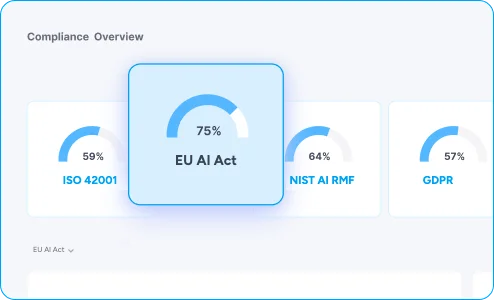
- Track compliance progress by requirement area across all clients in one dashboard
- Maintain documentation libraries that evolve as guidance and standards mature
- Deliver executive-ready reports that keep leadership informed and engaged
Framework FAQs
Yes, for in-scope organizations. It is a binding EU regulation with a phased timeline: prohibitions applied from early 2025, general-purpose AI obligations from mid-2025, and most high-risk system requirements through 2026 and 2027.
Yes. The regulation has extraterritorial reach — it applies to providers and deployers outside the EU when their AI systems are placed on the EU market or their outputs are used in the EU.
AI used in areas the regulation designates as high risk — including employment and hiring, credit scoring, education, essential services, and law enforcement — as well as AI that is a safety component of regulated products.
Fines scale by violation type, reaching up to EUR 35 million or 7% of global annual turnover for prohibited AI practices, with lower tiers for other breaches.
Cynomi automates AI governance assessments, generates policies, tracks remediation tasks, and maintains audit-ready documentation — enabling MSPs and MSSPs to deliver AI Act readiness services across their client base at scale.