


We talk a lot about AI, cloud expansion, and ransomware that grows more sophisticated by the month. Those threats are real. But in my years working with organizations of every size, I’ve found that the biggest cybersecurity downfalls rarely come from exotic attacks. They come from missing fundamentals: governance, accountability, visibility, and clear risk ownership.
I recently sat down with APT & Cyber Security to talk through this in detail. My core message is simple. Treat cybersecurity as a core business function, not a technical afterthought.
For MSPs, MSSPs, and IT and cybersecurity consulting firms building a cyber advisory practice, this blog post offers a practical playbook for delivering real value to clients.
Cybersecurity Is a Business Risk
The most common mistake I see leadership teams make is burying security too deep inside the IT department. Cybersecurity belongs in the boardroom.
It’s a business problem. There needs to be someone at the top, either in leadership or on the board, who decides what’s acceptable and what’s not.
My role as a security advisor is to surface the risk and say, “Here’s where your risks are.” The decision to accept or mitigate a potential $500,000 loss is a business choice. It belongs to the people who own the consequences. When leadership owns the risk, security becomes a driver of business resilience.
The “Sundae vs. Cherry” Analogy
Many organizations rush to penetration testing because it feels like definitive proof of security. In my experience, that puts the cart before the horse.
A highly regarded information security leader and acquaintance, Ira Winkler, has a great analogy to explain this. Responding to a LinkedIn post by Jacob Hill about Governance being greater than pentesting, he said “…the goal of a cybersecurity program is broadly to have nothing to be found during a pentest, which should be metaphorically the cherry on the top of a good cybersecurity program. GRC is the bowl for the sundae.”
Governance and basic controls are the sundae, and pen testing is the cherry on top. If you skip the foundation, a pen test is a waste of money because the vulnerabilities are already predictable.
The order matters.
Here’s how I work through it with clients:
• Inventory your assets, so you know what you’re protecting
• Harden your systems against known weaknesses
• Establish a documented information security program
• Validate the work with testing
Get the sundae right first. The cherry comes later.
Moving Beyond the Spreadsheet
For years, governance meant endless spreadsheets and manual tracking. The work was grueling, hard to standardize, and nearly impossible to communicate at the executive level.
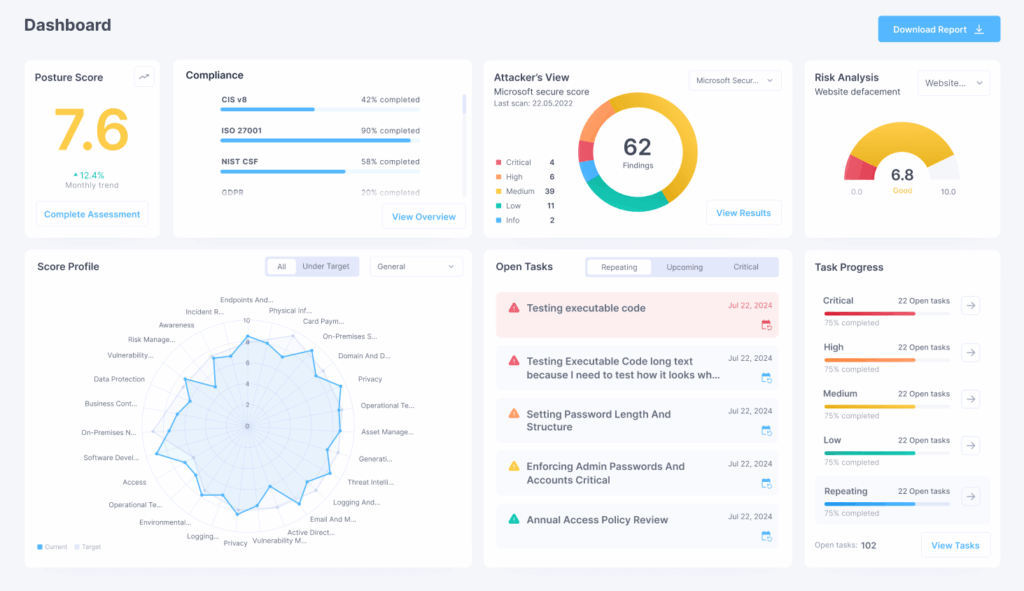
A platform changes that conversation. Instead of explaining technical jargon, a Cyber Advisor can present a clear, visual risk score that leadership understands right away. When a board sees the organization meets just three of 32 security profiles, the budget conversation shifts. Numbers move decisions.
This is where a partner like Cynomi has reshaped how we deliver, replacing spreadsheet-based assessments with automated workflows and visual reporting that clients understand. Their Security Growth Platform embeds CISO Intelligence into every step, making it possible to scale cyber advisory services without relying on a team of top experts for every engagement.
The “Pay Now or Pay Later” Reality
When people ask me for an uncomfortable truth executives need to hear, I don’t soften it. You pay now or you pay later, because you can’t keep pushing it off.
Cybersecurity is a non-negotiable cost of doing business. This includes managing third-party vendor risk, which is a “Trojan horse” of modern security, and making sure internal policies live in everyone’s job description. The ultimate goal is business resilience.
For MSPs, MSSPs, and IT and cybersecurity consulting firms, this is the value story clients respond to. Demonstrating ongoing risk reduction, not just a one-time report, keeps clients engaged and renewing year after year.
Cyber Advisory as a Force Multiplier
A full-time CISO is expensive, and turnover runs high, especially for small and mid-sized businesses. This is where cyber advisory services come in. Some organizations bristle at the term “vCISO” because it carries the CISO title, so we’ll call it cyber advisory, or whatever fits your culture. The point is the same: part-time strategic support that fills the gap.
I’m clear with every client that cyber advisory shouldn’t replace internal staff. It should serve as an extension of the team and act as a strategic sounding board. By providing foundational and strategic professional services on a part-time basis, a cyber advisor helps an organization establish a baseline and move forward methodically.
The Bottom Line
To stay in business, you must govern your environment. Start with the fundamentals, move away from manual tracking, and help leadership understand that cyber risk is, above all, business risk.
For MSPs, MSSPs, and IT and cybersecurity consulting firms, that shift from spreadsheets to scalable, governance-led delivery is the difference between a cyber advisory practice that strains your team and one that grows your business.
Cynomi is the platform we lean on to make that shift happen. Learn more about how Cynomi helps MSPs and MSSPs grow their practice.
Brad Mathis is a Senior Information Security Consultant and vCISO at Keller Schroeder, an employee-owned IT consulting firm founded in 1978, and a Cynomi partner.
Table of contents